
Wobbi: a 3D playroom for curious little minds
A project story about Wobbi, a free, ad-free browser playroom where babies, toddlers, and young kids learn by touching, building, listening, and exploring, with no sign-in for children.
- Kids
- early learning
- 3D
- privacy

Hover the browser to scroll the live page capture.
- Project
- Wobbi
- Type
- Product
- Status
- Live
- Sector
- Early learning
- What we built
- A 3D playhouse whose rooms open worlds, books, and games
- Play shaped for babies, toddlers, and kids up to eight
- No ads or tracking, with settings behind a grown-ups gate
- Live site
- wobbi.vibeboxph.com
Apps for small children often arrive with the habits of apps for adults: sign-ins, streaks, ads, and purchases a toddler can tap by accident. Wobbi takes the opposite position. It is a toy playhouse in the browser, free and ad-free, where each room opens a world and children learn by touching, building, listening, and exploring. No reading is needed.
The product problem
Designing for a one-year-old and an eight-year-old at the same time is the hard part. Wobbi had to:
- give babies big, forgiving targets and instant cause and effect;
- guide toddlers with names spoken aloud and simple listen-and-copy games;
- give older kids goals, real facts, and creations they can save;
- leave out everything that turns play into a compulsion;
- keep grown-up controls out of small hands.
The first screen is the toy
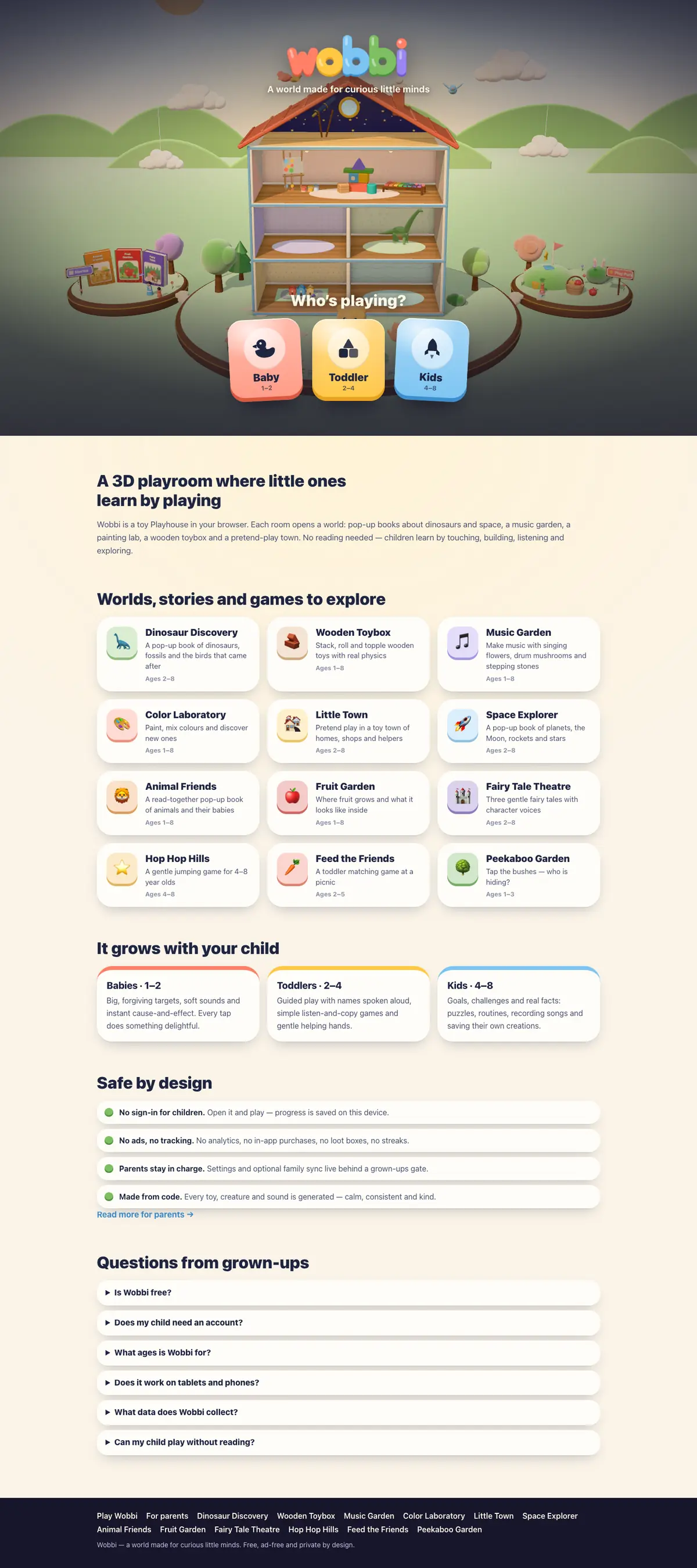
Wobbi opens on a 3D dollhouse in a little garden world: an attic under the stars, rooms with blocks and a xylophone, a dinosaur in the room below, and islands of books and fruit on either side. Beneath it, one question, "Who's playing?", with three large buttons: Baby, ages one to two; Toddler, two to four; and Kids, four to eight. The choice shapes the play that follows.
Worlds, stories, and games
Twelve worlds sit behind the doors, each with an age range:
- pop-up books about dinosaurs, space, animals and their babies, and where fruit grows;
- a wooden toybox with real physics for stacking and toppling;
- a music garden of singing flowers and drum mushrooms, and a color laboratory for mixing paint;
- a pretend-play town, a fairy tale theatre with character voices, and gentle games like Hop Hop Hills, Feed the Friends, and Peekaboo Garden.
It grows with your child
Each age band changes how the same worlds behave. For babies, every tap does something delightful. For toddlers, play is guided and names are spoken aloud. For kids, there are puzzles, routines, songs to record, and creations to save.
Safe by design
The safety section is short and specific:
- No sign-in for children. Open it and play, with progress saved on the device.
- No ads, no tracking. No analytics, no in-app purchases, no loot boxes, and no streaks.
- Parents stay in charge. Settings and optional family sync live behind a grown-ups gate.
- Made from code. Every toy, creature, and sound is generated, calm and consistent.
A page for parents and a plain FAQ answer the questions grown-ups ask: is it free, does my child need an account, what data is collected, and can my child play without reading.
What the work reinforced
- For small children, the interface is the content. Big targets and immediate feedback are the lesson.
- Leaving things out is a design decision. No ads and no streaks shaped every screen.
- Gate the grown-up controls. Children explore freely when settings are out of reach.
Continuing work
Wobbi is free to play now, and this story will be updated as new worlds arrive. If you are building for children, write down what you will never add before you plan what you will.
Keep reading
A project story about Barty Bakes, a bakery website in preview with a 3D build-a-box, GCash payments checked by a person, and pickup or delivery, ahead of online ordering opening.
Project story · 3 min readDayo: a social map where every review is a real visitA project story about Dayo, a living social map of places in the Philippines, shown as a playground on synthetic seed data, where every review is tied to a GPS-verified visit.
Start a project
Planning a website of your own?
Tell us what the website needs to accomplish. We reply with an honest fit review and the right next step.