
Dayo: a social map where every review is a real visit
A project story about Dayo, a living social map of places in the Philippines, shown as a playground on synthetic seed data, where every review is tied to a GPS-verified visit.
- Maps
- community
- travel
- Philippines

Hover the browser to scroll the live page capture.
- Project
- Dayo
- Type
- Product
- Status
- DemoA playground on synthetic seed data. Places marked SEED are fictional.
- Sector
- Travel and local discovery
- What we built
- Verified visits, checked by the server against each place's radius
- Live statuses that expire, and answers from people who were there
- Community events at real places, with caps and safety notices
A review is only as useful as the visit behind it. Star ratings from people who never went, and photos from three years ago, make it hard to decide whether a café has outlets, a campsite has signal, or a road is passable for a sedan. Dayo's answer is one rule: every review is tied to a real visit.
Dayo is a living social map of places in the Philippines. The public site runs as a playground on synthetic seed data: places marked SEED are fictional, seed photos are generated by code, and the counts on the homepage come from that seed data.
The product problem
Trust in a places app is mostly a data problem. Dayo had to:
- confirm that a reviewer was really there, without exposing where anyone is;
- show what is happening now, not what was true last month;
- let people ask questions of those who just went;
- bring people together at real places, safely.
From discovery to return
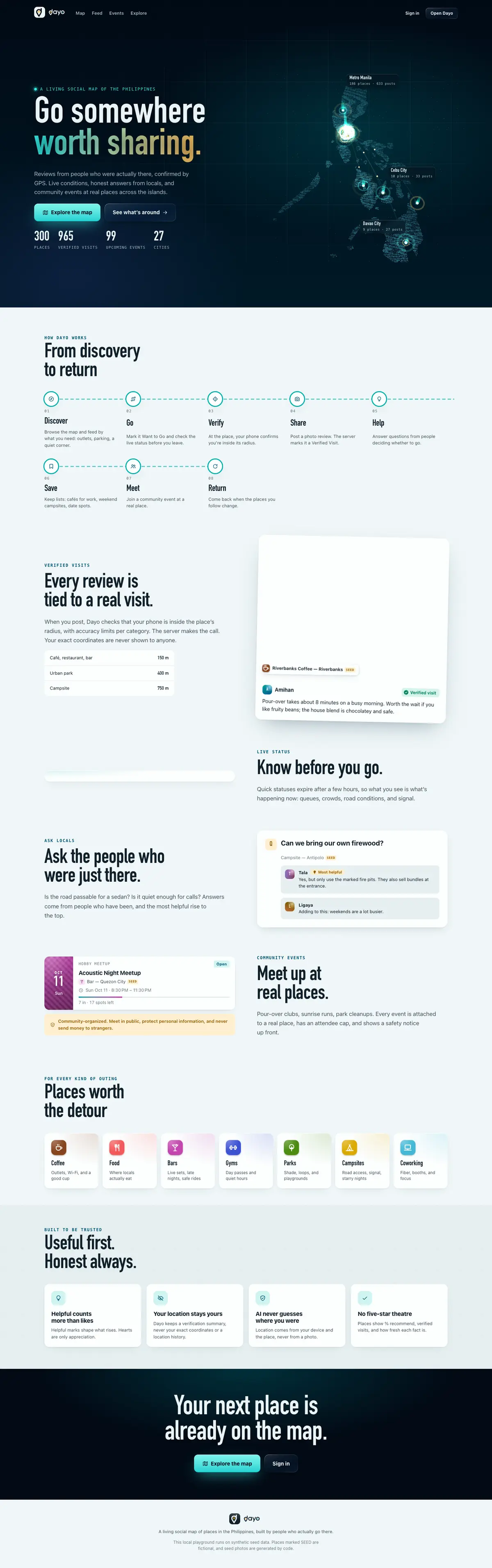
The homepage lays out the loop in eight steps: discover a place by what you need, mark it "Want to go" and check its live status, verify when you arrive, share a photo review, help others who are deciding, save lists, meet at community events, and return when the places you follow change.
Verified visits
When someone posts, Dayo checks that their phone is inside the place's radius, with limits per category: 150 meters for a café, restaurant, or bar, 400 for an urban park, and 750 for a campsite. The server makes the call, and the review is marked as a verified visit. Exact coordinates are never shown to anyone, and Dayo keeps a verification summary instead of a location history.
AI never guesses where you were
Location comes from the device and the place, never from a photo. It is a small sentence on the site, and an important product decision.
Know before you go
Quick statuses, such as queues, crowds, road conditions, and signal, expire after a few hours, so what a visitor sees is what is happening now. Questions go to people who have been there, and the most helpful answers rise to the top.
Meet up at real places
Pour-over clubs, sunrise runs, and park cleanups are attached to real places, with an attendee cap and a safety notice up front: meet in public, protect personal information, and never send money to strangers.
No five-star theatre
Places show the share of people who recommend them, the number of verified visits, and how fresh each fact is. Helpful marks shape what rises, while hearts are only appreciation.
The design
The hero is a dark map of the islands, with glowing clusters over Metro Manila, Cebu, and Davao and a headline that shifts from teal to gold. Below it the site turns light and calm, with steps, rules, and examples set out like a field guide.
What the work reinforced
- Trust is a data rule. Verification happens on the server, where it cannot be faked by the interface.
- Expire what goes stale. Live information is useful because it disappears.
- Keep summaries, not histories. Privacy is easier to promise when the data does not exist.
Continuing work
Dayo is shown as a playground on seed data, and this story will be updated as real places and people arrive. If you are designing a review product, decide what makes a review count before you design how it looks.
Keep reading
A project story about Barty Bakes, a bakery website in preview with a 3D build-a-box, GCash payments checked by a person, and pickup or delivery, ahead of online ordering opening.
Project story · 3 min readEmdee: Health Hav-its, one capsule a dayA project story about the Health Hav-its website for Emdee Chem Marketing Corp. of Quezon City, in business since 1997, with three supplement formulas, every dose printed, and direct ordering.
Start a project
Planning a website of your own?
Tell us what the website needs to accomplish. We reply with an honest fit review and the right next step.