
Karaoke Night: a karaoke stage on any TV
A project story about Karaoke Night, a browser-based karaoke stage where guests join from their phones, line up songs in a fair shared queue, and cheer from their seats.
- Entertainment
- realtime
- parties
- karaoke
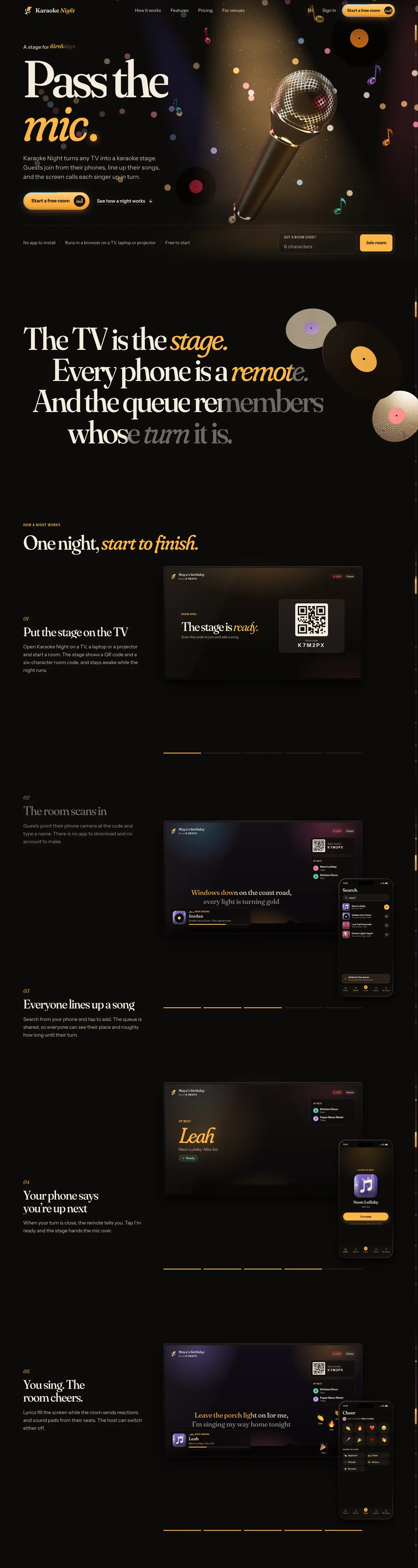

Hover the browser to scroll the live page capture.
- Project
- Karaoke Night
- Type
- Product
- Status
- LiveFree rooms are open now. Paid plans are listed, with pricing still to be announced.
- Sector
- Entertainment
- What we built
- A TV stage with a QR code and a six-character room code
- Phone remotes for search, the shared queue, and reactions
- Host controls: fair-turn limits, a room PIN, nearby-only joining
- Live site
- karaokenight.vibeboxph.com
Karaoke nights usually stall on the remote. One person holds it, the song list lives in their head, and the shy guest who wanted one song never gets a turn. Karaoke Night moves the whole night into the browser: the TV becomes the stage, every phone becomes a remote, and the queue remembers whose turn it is.
Free rooms are open now. Paid plans for bigger parties and venues are listed on the site with their pricing still to be announced.
The product problem
A party tool has to work in the first minute or nobody uses it. Karaoke Night had to:
- run on the screen people already have, whether a TV, a laptop, or a projector;
- let guests join with no app to install and no account to make;
- keep the queue fair when one enthusiastic singer would happily book the night;
- give the host control without making them chase a remote mid-song;
- work in a living room and in a busy bar.
How a night works
The site walks through one night in five steps, and each step removes a reason to give up:
- Put the stage on the TV. Start a room and the stage shows a QR code and a six-character room code, and stays awake while the night runs.
- The room scans in. Guests point their phone camera at the code and type a name.
- Everyone lines up a song. Search from your phone and tap to add. The shared queue shows each person their place and roughly how long until their turn.
- Your phone says you are up next. Tap "I'm ready" and the stage hands over the mic.
- You sing. The room cheers. Lyrics fill the screen while guests send reactions from their seats.
Small details that prevent friction
Room codes never use the letters I and O or the numbers 0 and 1, so nobody squints at the TV wondering which one it is. The join form on the site repeats that rule right under the field.
Run the room from the stage
The host's controls live on the stage screen: pause, skip, reorder, or remove songs, lock the queue at last call, and decide who gets in. Each singer has a queue limit, so one guest cannot take over. Closed rooms can require a six-digit PIN, accept only phones near the stage, and use a stage QR code that refreshes itself. The homepage includes a host panel to try, clearly marked as a demo that does not touch a real room.
Cheer from your seat
Guests send reactions and sound pads, from applause to a drumroll, and the stage plays them for everyone. Hosts can switch reactions and sounds off for their room. The homepage lets visitors try the pads on a sample stage, which explains the feature faster than any paragraph.
Plans without invented prices
The plans compare how many people each party admits, how many songs a day it sings, and how much the stage keeps between nights: Free, Party Pass, Party Pro, and Venue Pro. Only the free plan can be started today, and the others say "Pricing announced soon" instead of showing placeholder figures.
What the work reinforced
- Take installs out of the guest path. A camera scan and a name is the whole sign-up.
- Fairness is a feature. Queue limits and a visible order keep the night friendly.
- Design for the back of the room. Big type, a readable queue, and codes that cannot be misread.
Continuing work
Karaoke Night is live for free rooms, with paid plans and venue features listed as they come. This story will be updated as those ship. If you are building a product for groups, design the first sixty seconds for the least patient person in the room.
Keep reading
A project story about Barty Bakes, a bakery website in preview with a 3D build-a-box, GCash payments checked by a person, and pickup or delivery, ahead of online ordering opening.
Project story · 3 min readDayo: a social map where every review is a real visitA project story about Dayo, a living social map of places in the Philippines, shown as a playground on synthetic seed data, where every review is tied to a GPS-verified visit.
Start a project
Planning a website of your own?
Tell us what the website needs to accomplish. We reply with an honest fit review and the right next step.