
Kaha: the point of sale you talk to
A project story about Kaha, a voice-first and offline-first counter app for sari-sari stores, eateries, and cafes, in Android beta, with a browser demo that runs its real order parser.
- Retail
- point of sale
- voice
- Philippines

Hover the browser to scroll the live page capture.
- Project
- Kaha
- Type
- Product
- Status
- BetaAn Android beta. Plan prices are announced at launch.
- Sector
- Retail point of sale
- What we built
- Selling by voice, tap, or scan, with an offline order parser
- Sack and bundle prices, utang balances, and payday reminders
- A browser demo that runs the real parser on a sample store
The counter of a sari-sari store moves fast. Hands are full, orders arrive in Taglish, rice sells by the kilo and by the sack, and credit lives in a notebook. Most point-of-sale apps are built for a cashier with a scanner and a quiet queue. Kaha is built for the counter as it really is: say "dalawang coke at isang piattos" and it rings up the order, counts the change, takes the stock out, and remembers who owes what.
Kaha is in an Android beta. Selling is free, and plan prices are announced at launch.
The product problem
A small store's tool has to survive a brownout and a lunch rush on the same day. Kaha had to:
- understand orders in English, Filipino, or Taglish, with numbers said as words;
- keep selling with no signal, on the Android phone the owner already has;
- handle bulk prices, from a kilo of rice to a sack, without mental math;
- track utang and loans, and remind the owner when payment was promised;
- let anyone sell while keeping prices and reports behind the owner.
A day at the counter
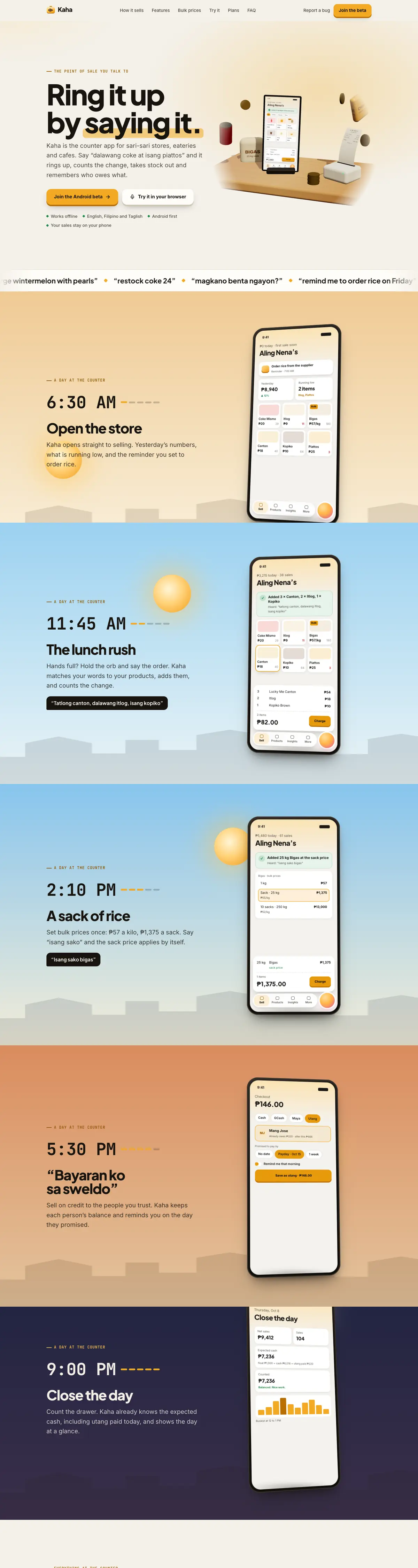
The homepage tells one day from opening to closing. At 6:30 AM the store opens to yesterday's numbers, what is running low, and a reminder to order rice. At 11:45 AM, the lunch rush: hold the orb and say the order. At 2:10 PM a customer asks for a sack of rice and the sack price applies by itself. At 5:30 PM someone says "Bayaran ko sa sweldo" and the sale goes on credit with a reminder. At 9:00 PM the day closes with the expected cash already counted, including utang paid today.
Everything at the counter
Kaha's feature grid reads like a store owner's checklist:
- Sell by voice. Kaha learns what customers call things, and understands "kalahating kilo".
- Bulk and bundle prices. Wholesale rates by the sack or case, or "3 for ₱100" deals.
- Utang and loans. Balances per person, who is overdue, and payday reminders.
- Scan and label. Barcodes for packaged goods, and printable QR labels for loose items.
- Products from a photo. Snap a price list and Kaha AI reads the names, then asks for prices.
- Cashier mode. Price changes, voids, and reports ask for the owner's PIN or fingerprint.
- Receipt printers. 58 mm Bluetooth thermal printers print order slips after each sale.
Try the real parser in the browser
The "Try it here" section runs Kaha's actual offline parser and pricing on a small demo store, right in the page. Visitors can type "Isang sako bigas" or "Kalahating kilo asukal" and watch the cart fill and the price follow the quantity. Nothing typed leaves the page. It is the most convincing argument on the site because it is not an argument at all.
Saying what it is not
The footer states plainly that Kaha prints and shares order slips, that they are not official BIR receipts, and that Kaha is not a BIR-accredited cash register. For a tool that handles money at a counter, that sentence matters as much as any feature.
What the work reinforced
- Design for the words people use. Taglish and numbers said as words are the input, not an edge case.
- Offline is a feature. A store that cannot sell during a brownout loses the day.
- Say what the product is not. Clear limits build more trust than broad claims.
Continuing work
Kaha is in an Android beta, and this story will be updated as it moves toward launch. If you are building for small businesses, spend a day at the counter you are designing for before you draw a single screen.
Keep reading
A project story about Barty Bakes, a bakery website in preview with a 3D build-a-box, GCash payments checked by a person, and pickup or delivery, ahead of online ordering opening.
Project story · 3 min readDayo: a social map where every review is a real visitA project story about Dayo, a living social map of places in the Philippines, shown as a playground on synthetic seed data, where every review is tied to a GPS-verified visit.
Start a project
Planning a website of your own?
Tell us what the website needs to accomplish. We reply with an honest fit review and the right next step.