
Kaban: a money app that shows what is safe to spend
A project story about Kaban, a personal finance web app in private beta that sorts money into bills, goals, and a buffer, with Tala, a guide that drafts but never decides.
- Fintech
- personal finance
- AI
- Philippines

Hover the browser to scroll the live page capture.
- Project
- Kaban
- Type
- Product
- Status
- BetaFree during a private beta. The figures on the public site are sample numbers.
- Sector
- Personal finance
- What we built
- A safe-to-spend model you can try with sliders on the homepage
- Tala, a guide that drafts entries and waits for your Confirm
- Row-level security shown live, with sign-ins you can switch
A bank balance answers the wrong question. It says what you have, not what is already promised to rent, the electric bill, or the trip fund. Kaban starts from the question people actually ask before they spend: how much of this is safe to use until payday?
Kaban is the Filipino word for a chest where valuables are kept, and the product calls itself the alkansya, all grown up. It is a personal finance web app, free during a private beta, and the figures on its public site are sample numbers, labeled as such wherever they appear.
The product problem
Money apps tend to fail in one of two ways. Some ask for bank passwords before they show anything useful. Others show everything at once, in charts that never say what to do next. Kaban had to hold a few concerns together:
- one clear number, safe to spend, with the reasoning behind it visible;
- accounts, e-wallets, cards, and cash in one place, each currency kept separate;
- bills, goals, and shared costs that change the number before they surprise you;
- an assistant that helps without ever acting on its own.
Designing the first screen
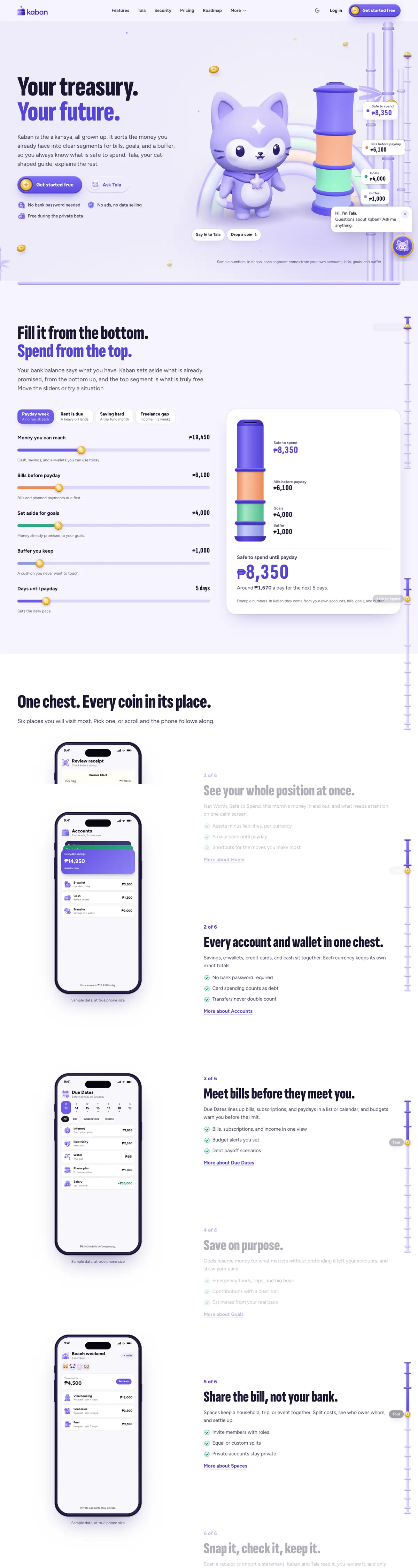
The homepage opens on "Your treasury. Your future." beside Tala, a cat-shaped guide, and a stacked chest of segments: safe to spend on top, then bills before payday, goals, and a buffer. Three short lines sit under the actions: no bank password needed, no ads and no data selling, and free during the private beta.
Letting visitors try the model
"Fill it from the bottom. Spend from the top." is the whole idea, and the site lets you test it. Sliders set the money you can reach, bills before payday, goals, buffer, and days until payday. Situations like "Rent is due" or "Freelance gap" move them for you. The result is a safe-to-spend figure and a daily pace, with a note that the example numbers come from your own accounts inside the app.
One chest, six places
A phone follows the reader through the six places they will visit most: Home, Accounts, Due Dates, Goals, Spaces for shared bills, and Receipts. Each one is shown with sample data at true phone size, next to the rules that make it trustworthy, such as transfers that never double count and goals that reserve money without pretending it left your accounts.
Tala drafts, you decide
Tala reads receipts, answers from the data you already keep, and turns a sentence like "I paid 549 for internet" into a draft. Nothing is saved until you press Confirm, AI features stay off until you opt in, and Tala says when something is unavailable instead of guessing. The homepage demo runs in the browser and saves nothing.
Showing the lock instead of claiming it
Security copy is easy to write and hard to believe. Kaban's site includes a small demonstration: switch who is signed in, between you, a friend who shares two Spaces, and a stranger, and watch the same question return different rows. Rows the person cannot see are marked as hidden by row-level security. The database decides, not the screen.
What the work reinforced
- Answer one question first. Safe to spend is the reason to open the app, so it leads every screen.
- Label sample numbers everywhere. A finance site that shows figures has to say whose figures they are.
- Let the assistant draft, not decide. Confirm stays with the person, every time.
Continuing work
Kaban is in a private beta, and its homepage keeps a short list of what changed recently, including a store workspace that is itself marked beta. This story will be updated as the product grows. If you are planning a product that handles money, design the trust signals as features people can try, not as badges.
Keep reading
A project story about Barty Bakes, a bakery website in preview with a 3D build-a-box, GCash payments checked by a person, and pickup or delivery, ahead of online ordering opening.
Project story · 3 min readDayo: a social map where every review is a real visitA project story about Dayo, a living social map of places in the Philippines, shown as a playground on synthetic seed data, where every review is tied to a GPS-verified visit.
Start a project
Planning a website of your own?
Tell us what the website needs to accomplish. We reply with an honest fit review and the right next step.